 707-349-8742
📧 consultingfirmwegner@gmail.com
707-349-8742
📧 consultingfirmwegner@gmail.com

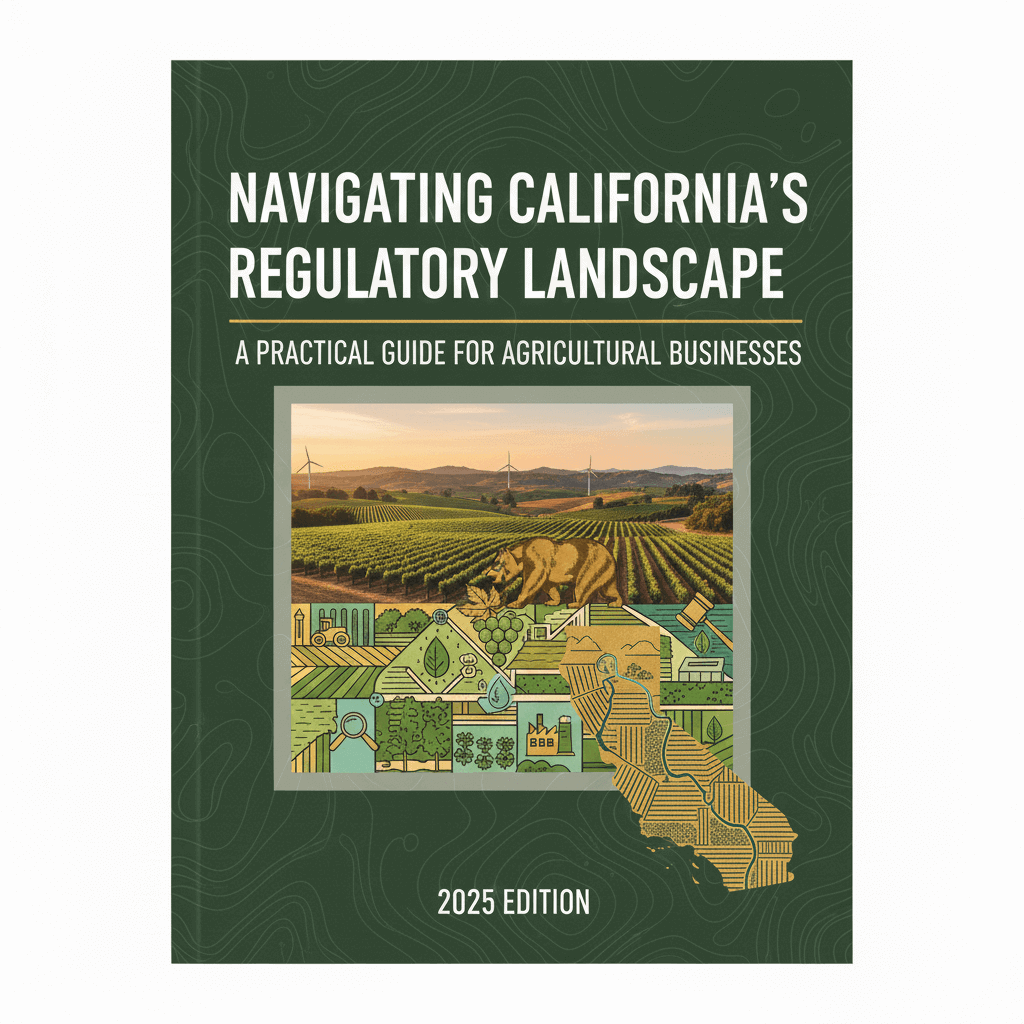
California agriculture is world-class — not only because of fertile soils and microclimates, but because the state pushes producers to operate under advanced environmental and regulatory standards. That pressure has created an agricultural ecosystem that leads the nation in sustainable farming, water conservation, food safety, and regenerative innovation.
But it also means that farmers are forced to operate inside one of the most complex regulatory environments in the United States.
Operating a vineyard, orchard, ranch, or commercial cultivation site in California means navigating a maze involving:
- State agencies
- County Planning & Building Departments
- State and Federal environmental laws
- Regional Water Boards
- USDA/NRCS programs
- Air districts
- Special districts
- Tribal resource protection requirements
- Sustainability certifications
For most owners, the journey starts with a straightforward goal:
operate responsibly, follow the law, and build a profitable agricultural business.
What they discover is that to do that, they must learn to navigate:
- Environmental Laws
- Water-use Controls
- Air-quality Restrictions
- Cultural and Tribal Resource Protections
- Land use and Zoning Rules
- Hazardous Waste Restrictions
- Pesticide Regulations
- Certification Standards
- Evolving sustainability requirements
Why California’s Regulatory System is So Unique
Three forces shape California more than any other agricultural state:
1. Water Scarcity + Statewide Water Law
California’s water policy is built on priority rights, beneficial use, groundwater sustainability, and regional water quality protections.
- The State Water Resources Control Board (SWRCB) regulates water rights, diversions, and discharges.
- Each region has a Regional Water Quality Control Board (RWQCB) that issues permits and enforces compliance.
California leads the nation in:
- Irrigation efficiency standards
- Mandatory nitrogen reporting
- Groundwater sustainability (SGMA)
- Drought emergency authority
- Stormwater pollution controls
This means farming decisions are tied directly to:
- Water availability,
- Reporting requirements,
- Water quality compliance programs.
2. CEQA + Environmental Protection
Unlike other states, California Environmental Quality Act (CEQA) applies to the approval, not the project size.
Any discretionary permit triggers CEQA review.
This is why a “small farm” is not exempt simply because it is small.
CEQA requires local governments to identify and mitigate impacts to:
- Biological Resources
- Cultural/tribal Resources
- Water Resources
- Air Emissions (PM 2.5 and GHGs)
- Erosion and Sedimentation
- Traffic (Equipment Impacts)
- Noise Impacts
- Wildfire Risk
- Hazardous Materials
This requires qualified studies, from:
- Biologists,
- Archaeologists,
- Geologists,
- Civil Engineers,
- Cultural Resource Monitors,
- Hydrologists.
A CEQA file with weak evidence = delays.
A CEQA file with proactive mitigation = fast approvals.
3. Market Leadership + Certification Standards
California dominates in:
- Certified Organic Production,
- Sustainable Wine Certification (CCSW),
- Global Supply-Chain Certification (GlobalG.A.P),
- Regenerative Agriculture,
- Soil Health Innovation,
- Compost and Organics Diversion.
Unlike other states, many California growers achieve premium pricing because they can prove sustainability, not just claim it.
Buyers — from Whole Foods to European importers — want:
- Measurable Outcomes,
- Water Conservation Metrics,
- Carbon Impact,
- Soil Health Performance,
- Pesticide Transparency,
- Traceability.
California’s regulatory system forces farms to build the data-driven management systems that make those claims credible.
How the Approval Process Actually Works
Most agricultural operations in California must pass through all three layers:
Step 1: County Planning Review
Every project starts at the county level.
Even if the zoning map shows agriculture as a permitted use, counties often require:
- Major Use Permit (MUP)
- Site Development Permit (SDP)
- Agricultural Project Review
- Public Hearing with the Planning Commission
- Environmental Determination (CEQA)
Examples:
- Lake County Zoning Ordinance Article 27 requires cannabis projects to obtain a Major Use Permit, including a full project description, BMPs, and environmental documentation.
- Napa County requires erosion and stormwater protection plans before approving new vineyard development under the Napa County Conservation Regulations.
- Sonoma County applies VESCO standards (Vineyard Erosion and Sediment Control Ordinance) to protect sensitive watersheds.
County planners rely heavily on:
- Clear project descriptions
- Mitigation practices
- Resource surveys and memos
- Best Management Practices (BMPs)
If a project proactively includes these, the review process is faster and less adversarial.
Step 2: CEQA — Exemption or Full Review
CEQA can move in three ways:
A) Categorical Exemption
For genuinely minor actions:
- Small Buildings,
- Agricultural Accessory Structures,
- Minor Alterations of Land,
- Installation of Fencing,
- Replacing Equipment.
Common exemptions:
- CEQA §15303 — Small Structures
- CEQA §15304 — Minor Alterations to Land
B) Statutory Exemption
Some activities are exempt by law:
- Emergency drought relief projects,
- Ongoing farming on existing agricultural land,
- Certain federal agency approvals.
C) Negative Declaration or EIR
If impacts cannot be dismissed or mitigated:
- Initial Study
- Mitigated Negative Declaration
- Environmental Impact Report (EIR)
This process takes:
- 6–18 months (Neg Dec)
- 12–36 months (EIR)
The key to speed is evidence, not argument.
Step 3: State Agencies & Special Programs
This is where the complexity becomes real.
Multiple agencies may have authority over a single farm
CDFA
California Department of Food & Agriculture
- Organic Certification
- Cultivation Licensing
- Soil Amendments
- Nursery Regulations
- Cannabis Cultivation Enforcement
CDPR
California Department of Pesticide Regulation
- Pesticide Licensing (QAL/QAC)
- Restricted Material Permits
- Application Reporting
- IPM compliance program
SWRCB
State Water Board
- Water Rights: appropriative and riparian
- Registration for livestock ponds
- Small Irrigation registration (SWRB 200)
- Stormwater General Permits (Industrial/Construction)
- Water Quality Enforcement Actions
Regional Water Boards
Enforce the Irrigated Lands Regulatory Program (ILRP):
- Annual Nitrogen Summary Reports
- Management Practice Implementation Report
- Sediment and erosion control
- Tailwater and stormwater discharge controls
This is one of the most enforced agriculture programs in California, especially in:
- Central Valley Region (R5),
- North Coast Region (R1),
- Central Coast Region (R3).
Non-compliance can result in:
- Notices of Violation,
- Administrative Civil Liabilities,
- Mandatory Corrective Actions,
- Fines Exceeding $10,000 per day.
Step 4: Special Considerations
Depending on the site, other laws can apply:
Tribal Cultural Resource Protection
- AB 52 Consultation requirements
- Tribal monitoring
- Cultural resource studies
If cultural resources exist, work stops until:
- Mitigation,
- Preservation,
- Tribal agreement.
Biological Survey Requirements
When protected species are present:
- California Red-Legged Frog
- Elderberry beetle
- Steelhead salmon
- Spotted Owl habitat
- Various oak woodland protections
Projects must include:
- Biological Surveys,
- Avoidance Buffers,
- Timing Restrictions.
Air Quality Districts
Each county has an Air District:
- PM 2.5 emissions from burning
- Diesel emissions from equipment
- Biomass disposal restrictions
Examples:
- Mendocino County AQMD
- Yolo-Solano AQMD
- Northern Sonoma AQMD
In 2024–2025, many districts have reduced open burn windows and are moving to organics diversion.
Common Mistakes That Cost Operators Time and Money
After decades of real-world experience, the same patterns repeat:
1. Treating the process like “paperwork”
Compliance is project management, not forms.
County planners expect:
- Maps,
- Surveys,
- Plans,
- BMPs,
- Technical Memos,
- Environmental Documentation,
- Management Plans.
Not just the application form.
2. Applying for CEQA exemptions without evidence
An exemption claim must include:
- facts that show no impact.
A letter that simply says:
“We believe we are exempt.”
will be rejected.
3. Ignoring nitrogen management and ILRP
The Water Boards have increased enforcement on:
- Nitrogen Loading,
- Reporting Accuracy,
- Third-party program audits.
A missing record = a violation.
4. Weak project descriptions
County planners don’t want marketing language.
They want:
- Acreage,
- Slope,
- Soil Classification,
- BMPs,
- Runoff Controls,
- Waste Plans,
- Water Demand Calculations,
- Species Survey Results.
5. Not understanding sequencing
Permits are sequential, not parallel.
A common mistake:
- Apply to one agency,
- Wait for approval,
- Start another process.
This can add a year of delay.
A professional consultant:
- Designs a multi-agency timeline
- Front-loads surveys
- Prepares mitigation ahead of comments
Best Practices for a Smooth Process
A successful project uses:
Integrated Project Management
This means every document:
- Supports the CEQA argument,
- Supports the planning narrative,
- Supports water use reporting,
- Aligns with BMPs.
One package. One story. Consistency.
Evidence-Based Mitigation
Propose mitigation before they request it.
Examples:
- Erosion Control Blankets,
- Native Seed Mixes,
- Riparian Buffers,
- Optical Wildlife Fencing,
- Low-drift Spraying Technology,
- Solar Pumps,
- Gravity Irrigation,
- Mycelium Waste Reduction.
A proactive project reduces agency risk.
Use recognized certifications
When you use:
- CCSW framework,
- Organic Plans,
- GlobalG.A.P.,
you prove that the operation is already following internationally recognized standards.
This builds trust with regulators.
Timeline Expectations
No serious agricultural project in California is completed in 60 days.
Typical realities:
- Small projects: 6–12 months
- Vineyards: 12–18 months
- Complex + sensitive lands: 18–36 months
- Cannabis projects: 18–48 months
A consultant who promises 90 days is setting a trap.
A professional:
- Sets Realistic Expectations,
- Builds a strategy,
- Manages Risk,
- Moves the process forward.
The Role of a Strategic Consultant
Wegner Consulting’s value is that we act as the translator between:
- Business Owners,
- Government Agencies,
- Engineers,
- Environmental Experts.
We don’t make government smaller — we make it navigable.
Our job is not to “fight” agencies —
it is to provide them with the information they need to approve the project with confidence.
That includes:
- Project Descriptions,
- Biological Assessments,
- Water Demand Calculations,
- Nitrogen Reporting Systems,
- Dust and Air Quality Mitigation,
- BMP Manuals,
- Neighbor Mitigation Plans,
- Tribal Resource Plans,
- Wildlife Protection Plans.
We build the documentation architecture behind a successful project.
Conclusion
California is one of the most challenging agricultural environments — which is exactly why it is one of the most profitable, innovative, and globally respected regions in the world.
Complexity creates:
- Discipline in operations,
- Documentation systems,
- Sustainability practices,
- Long-term resource protection.
The businesses that thrive here are not simply growers — they are operators.
They build compliance into their business model, not as a burden, but as a strategic advantage.
If you approach California’s regulatory environment with:
- Evidence,
- Preparation,
- Clear Documentation,
- Respect for the process —
you will reduce delays, control costs, and build a farm that is stronger than any change in regulation, climate cycle, or market condition.